Cristiano Ronaldo's luxury car collection is not a random pile of expensive metal. The defining episode came in January 2009, when he wrecked a Ferrari 599 GTB Fiorano in a tunnel near Manchester Airport. He walked away unhurt;the car did not. Coverage treated the crash as a parable about youth and speed, which was too neat. The 599 was a front-engine V12 grand tourer with a reputation for being brutish in wet weather, and it was also a working symbol of his first great leap, from Manchester United's No. 7 to Ballon d'Or winner. The crash made the symbol louder. Cristiano Ronaldo's luxury car purchases are rarely just cars;
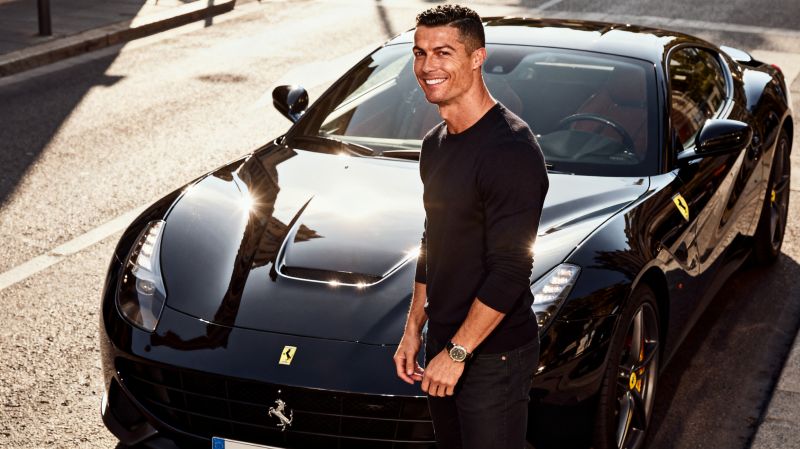
they are timestamps. The Ferrari marked the moment his talent began to look inevitable。and the wrecked chassis reinforced the point.Rolls-Royce occupies a different lane in the same story. Ronaldo has been photographed with a Phantom and a Cullinan, and the Cullinan makes more sense for his current life: tall, quiet, rear-hinged doors, room for family and security staff. Footballers collect SUVs for unglamorous reasons. Training grounds have tight car parks, sponsors want arrivals, and children do not fit neatly into a carbon-fiber tub. The Cullinan's 6.75-liter V12 and boxy profile are almost absurd, but the car solves a practical problem while projecting control. Cristiano Ronaldo's luxury car fleet is partly a logistics operation disguised as a fashion statement. The Phantom adds ceremony;the Cullinan adds school-run utility. Neither car is subtle, yet both are more discreet than a Lamborghini, which is exactly why they appear so often around his hotels。sponsorships, and family trips.Lamborghini supplies the theater. The Aventador, with its scissor doors and naturally aspirated V12 bark, is the car people expect from Ronaldo, and he has leaned into that expectation. The Urus is the compromise: an SUV with a Lamborghini badge, fast enough for a photo op and usable enough for an airport run. Bugatti is another category altogether. A Chiron or Centodieci is not transport;it is a limited-edition object, and the Centodieci。
capped at ten units, belongs in a collection rather than a daily rotation. Its 8.0-liter W16 engine is engineering as spectacle. Cristiano Ronaldo's luxury car purchases have become alternative assets. Limited-run Ferraris, Bugattis, and Porsche specials can appreciate, while ordinary luxury sedans depreciate like office furniture. That is the part fans miss: the collection is a portfolio with exhaust pipes. The taste is loud, but the financial logic is cold.The 2009 Ferrari crash still matters because it showed how he handles a mistake. He was 23, recently crowned the world's best player, and the tunnel near Manchester Airport could have become a cautionary tale. He did not retreat into a Prius or perform frugality for the cameras. He replaced the car, kept driving, and let the incident become part of his lore. That response fits his public character: competitive, unapologetic, slightly impatient. Cristiano Ronaldo's luxury car image survived because he never pretended that cars were merely appliances. He likes the noise。
the attention, and the engineering. A Ferrari in a tunnel is a stupid place to test grip, but it is a very human place to test a young man's sense of invincibility. The lesson was not that he should drive slowly. The lesson was that every vehicle he owns would be read as an extension of his ambition.Compare his garage with a connoisseur's collection and the difference is obvious. Jay Leno's garage is a museum of mechanical curiosity;Ronaldo's is a brand extension. The cars are chosen to match his body language: glossy, expensive, a little theatrical. There is speed for youth, space for family, and rarity for legacy. A Rolls-Royce Cullinan handles the present, a Lamborghini Aventador handles the myth。and a Bugatti handles the future value. The collection also tracks his career geography, from Manchester and Madrid to Turin and Riyadh. Cristiano Ronaldo's luxury car collection is ultimately a public diary written in horsepower. The entries are not subtle, and that is the point. He has spent two decades turning physical excellence into a global brand, and the cars make that conversion visible in a way a contract or a trophy cannot. You may find the display excessive. You cannot call it accidental.